
Parental Alienation
Our board-certified psychiatrists offer trusted evaluations and compassionate support for families facing parental alienation.
Schedule An
Appointment
Find A psychiatrist

Gaba Telepsychiatry provides evaluations for custody, legal, & family court matters.
The term ‘parental alienation syndrome’ was first coined by Dr. Richard A. Gardner.’ He identified that a subset of children would show unexplained hostility towards one parent and unequivocal support of another parent.
While it is not uncommon for a child to appear closer to the other parent, when the preference is extreme and unexplained, this may be a sign of a more sinister form of manipulation.
The child is not only made to feel that they have to choose sides, but also fears anger, hostility, rejection, and wrath from the alienating parent if they choose to adopt a neutral approach.
Likewise, they fear inducing anger from the other parent if they express a desire to maintain a relationship with both parents. Instead, the child rejects the alienated parent in order to appease the alienating parent.
Parental alienation should be considered when a child cannot give reasons for rejecting a parent, or provides shallow or frivolous reasons for rejecting a parent, and unequivocally supports the other.
The dynamic can mirror bullies in the school playground, where children turn against the child being bullied to appease the school bully and avoid being bullied themselves.
In more extreme cases, the child will not only reject but make accusations against the alienated parent.
Children are sometimes coached or instructed to make false allegations against the alienated parent. This can have devastating consequences and can shatter the parent-child relationship, and the alienated parent starts to withdraw and give up.
The child in such situations, although compliant with the wishes of the alienating parent, will often experience depression and suicidal thoughts due to guilt or conflicted emotions they are not able to process or articulate.
Sometimes the behaviour is unconscious, and the child will parrot the alienating parent without understanding that they are being manipulated.
Why is parental alienation considered a form of child abuse?
Parental Alienation is a form of child abuse and has devastating consequences, both for the alienated parent and the child or children concerned.
The alienated child and parent may experience
- Depression
- anxiety
- panic attacks,
- suicidal ideation.
- Social withdrawal
- Decline in school performance.
It is important to identify the signs of parental alienation in the early stages. Early identification can help protect the relationship with the child and address concerning behaviors before they become more difficult to resolve. This helps with child support and also protects the emotional well-being of the child.
Difference between Estrangement and Alienation

Estrangement
Refers to a child’s rejection of a parent that is justified as a consequence of the rejected parent’s history of family violence, abuse, and neglect (Johnston, 2005).

Alienation
Refers to a child rejecting one of the parents without a clear reason, often due to manipulation by the other parent. It can lead to long-term emotional harm.
What is Parental Alienation?
Parental alienation is a term commonly used in child custody cases, referring to a situation where one parent manipulates a child to reject, fear, or show hostility toward the other parent, damaging the alienated parent and child’s relationship.
It often occurs in the context of divorce or separation, when former spouses may be involved in ongoing disagreements about parenting, custody and undermine the child’s relationship with the other parent.
This behavior can significantly affect the relationship with the child and make it difficult for the alienated parent to maintain a healthy connection.
Parental Alienation is a form of child abuse and has devastating consequences, both for the alienated parent and the child or children concerned. The alienated child and parent may experience depression, anxiety, panic attacks, and suicidal ideation.
Parental alienation is a serious and harmful behavior that can profoundly impact the lives of those involved, particularly damaging a child’s relationship with the alienated parent. It often leads to parental estrangement, where the child distances themselves from a parent without valid reasons. It is important to identify the signs of parental alienation in the early stages. Early identification can help protect the relationship with the child and address concerning behaviors before they become more difficult to resolve. This helps with child support and also protects the emotional well-being of the child.


Different ways one parent is alienating the child from the other parent
- Telling the child, the other parent doesn’t care about them (quoting twisted scenarios)
- Parent moving out of the house or changing locations with the child
- Not letting the unfavored parent and the child keep any contact via phone or any other means
- Making the child fearful of the other parent
- Not keeping the other parent informed of the child’s developments
- Brainwashing the child so that he or she starts hating the other parent. It's a common act during parental alienation
Watch out for the following signs in children that may need to be addressed immediately
- Requests from them not to attend activities they should be participating
- Requests from them not to contact people or stakeholders in their lives – like their friends, teachers, schoolmates and so on
- They display argumentative behaviors most of the time, regardless of the situation
- They fail to identify positive qualities or actions by you
- Not keeping the other parent informed of the child’s developments
- Responding with defiance or oppositional behavior to anything you say or ask for

Signs of Parental Alienation
Rejection of one parent.
The child may not want to visit, speak on the phone, or spend time with that parent. In some cases, there is very little interest in trying to maintain the relationship.
Negative View towards one parent.
The child may also have very little positive to say about the parent. When asked about their relationship, the conversation keeps coming back to what the parent did wrong, how the parent behaved badly, or why the child does not want contact.
Irrational reason for rejection.
Sometimes the reasons given for the child’s rejection do not seem to explain the level of rejection. A disagreement about rules, a punishment, or something relatively minor may be described as the reason for wanting to completely cut off the relationship.
Parent-child relationship undermined.
Ordinary things such as discipline, setting limits, or saying no to the child can start being described as proof that the parent is uncaring or does not love them.
Resistance to Rebuild the relationship.
The independent-thinker phenomenon happens when a child believes their reluctance to visit the less favored parent is due to their own independent judgment, rather than being influenced by the other parent’s manipulation. The child rejects the idea that they are a victim of parental alienation.
Weak, absurd, or frivolous rationalizations for the deprecation
The child frequently provides superficial or trivial excuses for avoiding interaction or maintaining contact with the parent they prefer not to be with.
Examples of weak and frivolous reasons for cruel rejection of one parent are ‘my father and I just don’t get along,’ or ‘Mom and I have nothing in common.
Impact of Parental Alienation
Exposure to toxic stress caused by this phenomenon has long-lasting effects on a child’s mind and child’s emotional welfare. It is damaging to the developing brain of children and the intensity of practiced parental alienation is closely regarded as abuse or violence as well.
There is little scholarly consensus that severe alienation is abusive to children (Fidler and Bala, 2010), and is a largely overlooked form of child abuse (Bernet et al, 2010), as child welfare and divorce practitioners are often unaware of or minimize its extent.
Children, staying with this alienating parent, can become completely dependent on this parent through psychological manipulation, as the parent may be very controlling of the child’s thoughts and feelings at all times.
Even with adult children actively experiencing parental alienation, a lot of effort is required to even realize what is going wrong and recovering from parental alienation disorder usually takes a very long time, even with regular therapy.
Examples of Alienating Behavior
Alienating behavior can take different forms, and these examples can help show the alienating parent’s behavior over time rather than a single isolated incident. It does not always involve directly telling the child to dislike the other parent. Sometimes it is seen in small things that happen repeatedly, such as:
- A parent may keep cancelling visits or give the child reasons why they cannot go to the other parent’s house. Calls may also be interrupted or made difficult.
- Negative comments about the other parent can become a regular part of conversations with the child. The child may be told that the parent does not care about them, cannot be trusted, or is a bad parent.
- The child can also be brought into disagreements between the parents. They may be told about court matters, money problems, relationship issues, or things that happened between the adults. In some cases, the child is asked to carry messages or find out what the other parent is doing.
- Another example is making the child feel uncomfortable about having a good relationship with the other parent. If the child comes home happy after a visit, talks about something they did together, or says that they miss the other parent, this may be met with anger, criticism, or a negative comment.
- There can also be interference with the other parent’s role as a parent. The child may be told that the parent’s rules do not matter, that they do not have to listen to them, or that the parent has no right to make certain decisions.
- Important information about the child may not be shared with the other parent. This could include school activities, medical appointments, changes in the child’s schedule, or other matters that a parent would normally be expected to know.
- Sometimes the problem is less direct. A parent may repeatedly blame the other parent whenever something goes wrong. Over time, the child can start seeing that parent as the reason behind problems even when the child did not witness what actually happened.
- A child can also be encouraged, directly or indirectly, to take sides. They may feel that being close to one parent means they are betraying the other, or that showing affection toward the other parent will upset the parent they live with.


Parental Alienation Syndrome
Parental Alienation Syndrome (PAS) describes a pattern of behavior in which one parent systematically alienates a child from the other parent by limiting contact between them, typically through manipulation and false accusations. It is also known as child alienation, where a parent attempts to undermine the relationship between a child and the other parent.
As a result, the child rejects or becomes hostile toward the other parent, leading to estrangement and emotional harm.
Children impacted by Parental Alienation Syndrome often have mixed feelings about their parents, which can make them unsure about who they are and their role in the family, often requiring treatment to address these deep-seated issues. The child might feel torn between their parents and struggle to understand their own identity. Parental alienation can also cause long-term emotional damage and affect the children’s foreseeable relationships and mental well-being.
The continued stress and emotional upset from this separation can harm the child’s emotional health, causing them to have a weaker sense of who they are and a confused view of their family relationships.
The alienating parent plays a key and often manipulative role. They work to damage the relationship between their child and the other parent by using various tactics. These can include speaking negatively about the other parent, making false claims, or manipulating emotions to create resentment and distrust.
While the alienating parent may claim to be protecting the child, their true goal is to control the child’s feelings and views. This behavior not only hurts the targeted parent but can also negatively affect the child’s emotional and psychological health, making it harder for them to build healthy relationships and trust others in the future.
A parental alienation custody evaluation can help diagnose parental alienation behaviors and support child custody cases. Our online psychiatrists provide evidence-based reports to prove parental alienation behaviors in court.


How to Prove Parental Alienation Syndrome?
A child who refuses to visit a parent has not automatically been alienated. That is the first thing to understand when trying to prove parental alienation syndrome. Courts want to know why the child feels this way, whether those feelings come from real experiences with the rejected parent, and what the other parent has done to shape them. Answering that means looking at the relationship before the conflict started, the child’s own words, and the conduct of both parents.
One bad weekend or a single heated argument will not carry a case. A pattern that holds up over months will. These are the areas an evaluator and the court usually focus on.
Find out what the relationship looked like before things changed. Was the child close to this parent? Did they play sports together, talk every day, go to them when something went wrong? Then pin down when it shifted. Sometimes the change follows a clear event, such as the separation, a custody filing, or a move. When a healthy relationship falls apart quickly and nobody can explain why, that deserves a closer look.
The question here is what the alienating parent has actually done, not what the other parent suspects. In most cases it comes down to small things that keep happening. A parent runs the other one down in front of the child, or cancels a visit at the last minute because something “came up.” Phone calls go unanswered. Report cards, doctor’s appointments, and school events never get passed along. And when the child comes home happy from the other parent’s house, the reaction is cold or angry, which teaches the child to keep quiet about enjoying the visit.
Proof usually comes from records. Text messages, emails, parenting schedules, and school communications show what was said and when. Teachers, coaches, relatives, and family friends who saw these interactions firsthand can back that up in their own words. A single incident means little by itself. A year of them lined up by date tells a clear story.
Listen to the reasons the child gives. A child with a genuine grievance can usually point to something specific that happened. A child who has been influenced often gives reasons that are vague, exaggerated, or oddly adult, such as repeating legal terms or describing events they could not have witnessed. Evaluators also notice whether the child seems guilty about having fun with the rejected parent, or feels they must pick a side. None of this proves parental alienation alone. It is one part of the picture.
This step protects the child as much as the parent. If a child avoids a parent because of abuse, neglect, domestic violence, or harsh parenting, that is estrangement, not alienation. A careful evaluator checks for these possibilities first and does not assume the other parent is responsible.
A board-certified psychiatrist or another qualified mental health professional can pull all of this together. They review court records, communications, school records, prior psychological evaluations, and information from therapists or other professionals, and they interview both parents and, where appropriate, the child. The findings go into a written report that attorneys and the judge can use. The report addresses whether alienating behaviors are present, how they are affecting the child, and what should happen next, which may include unification therapy or changes to the parenting schedule.
Why professional evidence matters
Parental alienation cases are seldom won on a single piece of evidence. Records, witness statements, family history, and the evaluator’s findings need to line up and tell the same story. When they do, the court has a much clearer basis for decisions about custody and the child’s emotional well-being. A parental alienation expert witness can also explain those findings to the judge in plain terms.

I was prepared for her appointments. The appointments were easy to schedule around my full-time schedule. The staff was knowledgeable and compassionate regarding my case. I found her compelling but still graceful in court. Her office maintained the highest level of professionalism I could have asked for. I could not thank them enough for their support!
I could see the concern and passion that Dr. Reddy exhibited as she learned of the plight of our battle in family court. You definitely want this professional, compassionate individual representing your interests as a protective mother in a family court battle. Thank you Dr. Reddy and staff! You are greatly appreciated
I needed an assessment for family court and it was difficult being I live in Florida, and I was dealing with family court in Maryland. It was tricky navigating this between states. Maryland DSS wanted me to fly up there from Florida for 3 days to get this assessment done and Dr.Reddy and her associates/staff were able to facilitate this lengthy assessment via Zoom, making a 3-day trip not needed which was so wonderful and…Read More
convenient for me. They sent their extremely thorough assessment to the necessary people in Maryland, and it resulted with me being reunified with my children. They were all very professional, compassionate, accommodating and competent. I would highly recommend Dr Reddy and her staff to anyone in need of such professionals
Symptoms of Parental Alienation Syndrome
Lack of ambivalence
Most children suffering from parental alienation syndrome view the alienated parent as wholly negative, with no positive or redeeming attributes. Usually, children have a balanced view of their parents, and do not need them as all good or all bad. Usually, children are somewhat forgiving of their parents and are able to look at their parents favorably, and focus on some good points despite being aware of their faults.
It is commonly observed in parental alienation cases that the child may reject a parent without any reason and become overly attached to the preferred parent. Therefore, addressing parental alienation disorder at an early stage can save the relationship between the child and the parent.
Spread of the animosity
Spreading animosity involves directing resentment towards the friends and/or extended family of the alienated parent.
It is important to identify the signs of parental alienation, for example, the child may also refuse to have a relationship with the parents of the alienated parent. The animosity can be spread to aunts, uncles and cousins related to the alienated parent.
The child may sense that they will experience the disapproval of the alienating parent if they want a relationship with the other side of the family. They may also be worried about hurting the alienating parent if they spend time with other family members who are not related to him or her. who are not related to him or her. Addressing parental alienation behaviors is important to promote the emotional well-being of the child. Also, limiting contact with a toxic parent may serve the child’s best interests.
A campaign of denigration
A campaign of denigration involves a child persistently and unfairly criticizing or defaming the alienated parent. This behavior is a common symptom of parental alienation syndrome. The child may say bad things about the alienated parent to therapists, teachers, judges and other family members.
A child suffering from parental alienation syndrome may believe any bad things that are told to them by the alienating parents, without questioning whether the information is true. Sometimes, even if they know the defaming statements are not true, they may continue to make them or repeat them to gain the approval of the alienating parent.
The presence of borrowed scenarios
This happens when a child develops beliefs influenced by false or distorted narratives about the targeted parent. It is a common symptom of parental alienation syndrome. In extreme cases, the child suffering from parental alienation will recite the ‘ borrowed scenarios,’ as if they have seen them themselves. For example, a child may say that he saw the alienated parent drinking and driving, even if it did not happen, or say that he saw the alienated parent hitting a sibling, even though the sibling in question denies it ever happened.
The independent-thinker phenomenon
The independent-thinker phenomenon happens when a child believes their reluctance to visit the less favored parent is due to their own independent judgment, rather than being influenced by the other parent’s manipulation. The child rejects the idea that they are a victim of parental alienation.
Weak, absurd, or frivolous rationalizations for the deprecation
The child frequently provides superficial or trivial excuses for avoiding interaction or maintaining contact with the parent they prefer not to be with.
Examples of weak and frivolous reasons for cruel rejection of one parent are ‘my father and I just don’t get along,’ or ‘Mom and I have nothing in common.
Reflexive support of the alienating parent in the parental conflict
A child suffering from parental alienation syndrome will reflexively support one parent, without making an effort to understand the facts. Otherwise, the reasons for siding with the alienating parent may not seem logical. This type of child’s behavior may also cause psychological harm to the child and the alienated parent.
Absence of guilt over cruelty to and/or exploitation of the alienated parent
When the child directs hateful or demeaning comments at the targeted or alienated parent, they seemingly do so without feeling any remorse or guilt. Inability to express feelings of guilt or accept ambivalence may lead to internal conflict and depression. This type of behavior can be a symptom of parental alienation syndrome that can cause lasting psychological harm and affect the mental health of the child and the alienated parent. For example, the alienated child is aware that they are hurting the feelings of the alienated parent by refusing to visit


Why is Parental Alienation Syndrome a Serious Concern in Child Custody Cases
Parental Alienation Syndrome can turn a child against one of the parents without any appropriate reason.
Parental Alienation Syndrome is often observed during high-conflict divorce cases.
Parental Alienation Syndrome can affect the child and the targeted parent emotionally.
Parental Alienation Syndrome may lead to fear, anger and confusion in children.
Parental Alienation Syndrome makes the co-parenting situation more difficult and stressful
Parental Alienation Syndrome is an important factor that can affect the outcome of custody decisions in court.
What has changed, why the client is now fit to return to work, and why they are no longer a danger to themselves or others.
Parental Alienation Syndrome may continue for years if not treated early.
Parental Alienation Psychiatrist

Dr. Gundu Reddy
Board Certified Psychiatrist
with Multiple State Licenses MBBS (MD)

My name is Dr Reddy, and quite by accident, I started completing fitness to parent evaluations. During this process, I became involved with some heartbreaking parental alienation cases. As well as unification therapy, we are able to complete evaluations and consult for attorneys at a very reasonable price. The parental alienation reports save clients tens of thousands on legal fees, years in court, and a lot of heartbreak.
Often, the process goes on for years, and the child or children are already in their late teens by the time the court catches up and supervised visitation or therapy is enforced. I love parental alienation work because there is a crying need, and the chance to unite children with parents via unification therapy, helping the courts and judges understand and enforce healthy co-parenting practices.
The purpose of intervention is to prevent permanent alienation. It requires a keen eye, and experience to review all the records, text messages, emails observe behavior patterns , both with regards to alienating parents, and alienated children. We also work closely with alienated parents who often lose hope and confidence, and present with depression, anxiety, PTSD.
Many alienated parents report years of abuse during their marriage, which continues following divorce or partner separation through withholding, slander, campaign of defamation , and alienation of children. As well as counseling we teach parents not to react , and modify behaviors which may make them targets for alienation such as strict parenting, and tech parents to communicate with their children.
My team and I look forward to welcoming you to our practice.
Medical School
The United Medical Dental Schools of Guys Kings and St Thomas’ at King’s College London
Psychiatry Residency Training
Mount Sinai School of Medicine, New York
Psychodynamic Psychotherapy Training
NYU Psychoanalytic Institute
Board Certification
American Board of Psychiatry Neurology

Dr. Lynn Alison Bornfriend
Special interest in Child & Adolescent psychiatry
Psychiatrist with Multiple State Licenses (MD)

Dr Bornfriend is a triple board-certified psychiatrist with 30+ years of experience trained first with four years in adult psychiatry before completing child psychiatry and now she treats both children and adults across Illinois, South Carolina, California, Pennsylvania, Tennessee, New Jersey, North Carolina and Hawaii.
She is passionate about supporting patients dealing with a variety of disorders, including:
- Generalized Anxiety Disorder, separation anxiety, social anxiety disorder, phobias, panic disorder
- Mood Disorders, disruptive mood dysregulation disorder, major depressive disorder, premenstrual dysphoric disorder, bipolar affective disorder and cyclothymia
- OCD, body dysmorphic disorder, trichotillomania, excoriation
- Autism Spectrum Disorder
Reactive Attachment Disorder, adoption-related issues - PTSD, acute stress disorder, adjustment disorder, prolonged grief disorder
- Oppositional Defiant
- Disorder, intermittent explosive disorder, conduct disorder
- Eating Disorders, Sleep Disorders
- Gender Dysphoria
- Substance Dependence and Abuse
- Psychiatric Disorders Secondary to Medical Illness
Dr Bornfriend considers all symptoms presented through the lens of the individual patient’s developmental stage, while also evaluating the impact of family dynamics, environment, academic experience, and developmental/genetic variants. She understands the shift in the importance of autonomy and self-determination as the child grows towards adulthood, assisting the patient and his/her family with active empathic listening and respectful communication.
She has worked with children and adolescents as well as their families, their schools, and the court systems in a variety of modalities from evaluation and diagnosis, medication management, and individual and family therapies, from a supportive, insight-oriented, and CBT/DBT and other modalities.
Dr Bornfriend’s patients have appreciated her varied experiences and training throughout her career. They appreciate her creativity, her warmth, her humor, her intellectual curiosity, and her ability to connect with a wide variety of patients, despite varied backgrounds and levels of psychological mindedness. She has formed long-term, long-lasting relationships with patients, which have hada dramatic impact on their current life experiences as well as their futures.
Medical School:
Pennsylvania State College of Medicine–Hershey, PA
Psychiatric Residency Program:
Timberlawn Psychiatric Hospital–Dallas, TX
Child and Adolescent Psychiatry Fellowship:
Timberlawn Psychiatric Hospital–Dallas, TX
Board Certifications (American Board of Psychiatry and Neurology):
Psychiatry; Child and Adolescent Psychiatry; Forensic Psychiatry
Currently licensed in IL, SC, CA, PA, TN, NJ, NC and HI.

Dr. Beena Saad
Triple Board Certified Psychiatrist
with Multiple State Licenses (MD)

Dr. Beena Saad is a triple board-certified child and adult psychiatrist with extensive experience in forensic evaluations. Dr. Saad received her child psychiatry fellowship training from the University of New Mexico and child psychosomatic medicine fellowship training from Montefiore Medical Center/Albert Einstein College of Medicine.
Dr. Saad conducts evaluations related to parental alienation cases, including those that involve a child potentially becoming estranged from a parent. Dr. Saad will listen intently to the concerns brought by the family and review the family history, the relationship between the child and both parents, and any other potential causes for the behaviors of the child.
While conducting a parental alienation evaluation, Dr. Saad includes:
- An understanding of the nature of the relationship between the child and both parents.
- A review of the family history and the concerns raised by both parents.
- An assessment as to whether any actions taken by a parent might affect the child’s relationship with the other parent.
- Identification of other possible causes for the resistance felt by the child toward a parent.
- Evaluation of the emotional needs of the child.
With professional integrity, patience, and attention to detail, she devotes her time to comprehensively understanding the individual before making any judgments. Every analysis that Dr. Saad undertakes involves a compassionate, objective, and respectful approach to ensure that her clients feel understood in the process.
Dr. Saad is able to clearly convey information related to parental alienation evaluations. It is important to note that she is keen on updating herself on current research and thus regularly reviews medical literature. Dr. Saad aims to produce credible and comprehensive evaluations that will be of great help when making decisions during difficult times.
Schedule an Appointment with our Online Psychiatrists
Clinical Services: California, Florida, Illinois, New Jersey, New York, South Carolina, Tennessee , Long Island
Forensic Psychiatry Services: All of the US and Canada


Book Your Appointment in 5 Easy Steps
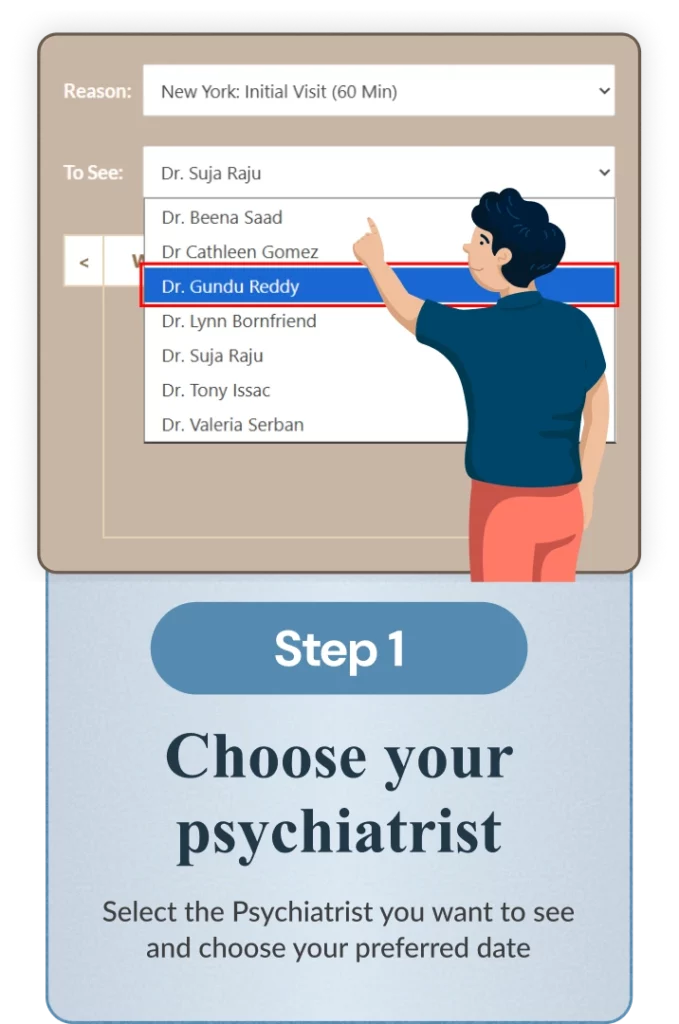









| State | Dr. Beena Saad | Dr. Tony Issac | Dr. Valeria Serban | Dr. Lynn Alison Bornfriend | Dr. Cathleen Gomez | Dr. Gundu Reddy | Dr. Suja Raju |
|---|---|---|---|---|---|---|---|
| California | Yes | – | Yes | Yes | – | Yes | – |
| Illinois | – | – | Yes | Yes | – | Yes | – |
| Florida | – | – | – | – | Yes | Yes | – |
| New Jersey | – | Yes | Yes | Yes | – | Yes | – |
| New York | Yes | Yes | Yes | – | Yes | Yes | Yes |
| South Carolina | – | – | Yes | Yes | – | Yes | Yes |
| North Carolina | Yes | – | – | Yes | – | Yes | Yes |
| Tennessee | – | – | – | Yes | – | Yes | Yes |
If you need help scheduling or have more questions,
Please call 18333124222 and ask for a patient advocate or forensic co-ordinator.
Parental Alienation Expert Witness
A parental alienation expert witness is a specialized professional required in legal custody disputes, especially in cases where one parent is suspected of turning the child away from another parent, that is, alienating.
These parental alienation experts are usually board-certified psychiatrists, or a clinical psychologist PHD, who have had specialist training in family systems, child development, psychodynamics, and high-conflict custody cases. They are often experienced in parenting evaluations, child custody, as well as parental alienation evaluations.
Several Board Certified Parental Psychiatrists at Gaba Telepsychiatry are experts in evaluating both children and adults for signs of parental alienation and alienating behaviors.


Evaluate Family Dynamics
They carry out extensive assessments of the children, parents, and occasionally the other extended family members. These assessments can include interviews, observation, psychological testing, and analysis of verbal or written communications or legal documents.
Identify Signs of Parental Alienation Syndrome
The expert will look for different behavioral patterns of the child, which might include unwarranted fear, contempt, or rejection of one of the parents.
They will also look at the extent to which they believe the child’s attitude results from overt or covert influence, or whether it is the consequence of the pressure exerted by the other parent.
Identify Alienating behaviors that can be addressed in court-
These include disparaging one parent, a campaign of defamation,
undermining one parent, not respecting a parent’s parenting time,
excluding the parent from access to school transcripts or medical information.
Review of evidence-
This can include text messages, emails, police
and CPS records, collateral from therapists, neighbours, and friends.
Provide Objective Testimony
The main responsibility of the expert is to provide impartial, evidence-based opinions to the court. The expert distills complex psychological concepts into everyday language that judges and attorneys, and other people can understand, so that the court can make informed decisions regarding custody and visitation.
Recommend Interventions to facilitate unification
An expert may also provide recommendations based on their findings for treatment methods, visitation, reunification therapy, or adjusting custody arrangements.
Their recommendations would solely be aimed at protecting the child’s mental health and restoring healthy relationships.
They can also recommend consequences for alienating behaviors and enforcement of court orders. This can be via co-parenting therapists or communication with the guardian at litem.
Provide recommendations for the alienated parent
Alienated parents may inadvertently be participating in behaviors that make them vulnerable.
- Rigid parenting style
- Not allowing access to friends or extracurricular curriculums
- Imposing religious beliefs
Not receiving treatment for depression and anxiety.
- When a parent is depressed and anxious, a child may also feel depressed and anxious in their presence.
- Not speaking openly about past issues, for example, past substance abuse, extramarital affairs, which children are aware of, and want answers.
While this is very much the role of the unification therapist, a parental alienation evaluator may also provide recommendations as to what the alienated parent can do to address concerns of the children and help distinguish between reasonable and unreasonable concerns.
Identify unreasonable complaints
Unreasonable complaints include
- Limiting screen time
- Limiting sleepovers
- Not allowing marijuana or alcohol
- Enforcing homework
- Enforcing bedtime
- Enforcing reasonable chores
- Enforcing attendance at family events such as birthdays, anniversaries
- Enforce basic respect and consequences for cursing or threatening behavior.
Help Courts Understand Long-Term Impact
The expert helps the court understand the gravity of the situation, especially about the effects that may occur on the child due to parental alienation, like anxiety, depression, etc. This makes sure that the court passes the verdict in favor of the child.
At Gaba Telepsychiatry, parental alienation experts will evaluate each case with compassion as well as clinical expertise, providing objective impressions, evidence-based testimony, and reasonable recommendations to protect the child’s mental health and make longer-term reunification possible. A professional consultation can help parents understand the evaluation process and determine what type of documentation or assessment may be appropriate for their circumstances.

Parental Alienation Syndrome can cause deep emotional harm. Connect with a board-certified psychiatrist today for expert evaluation and compassionate support.
Effects of Parental Alienation Syndrome
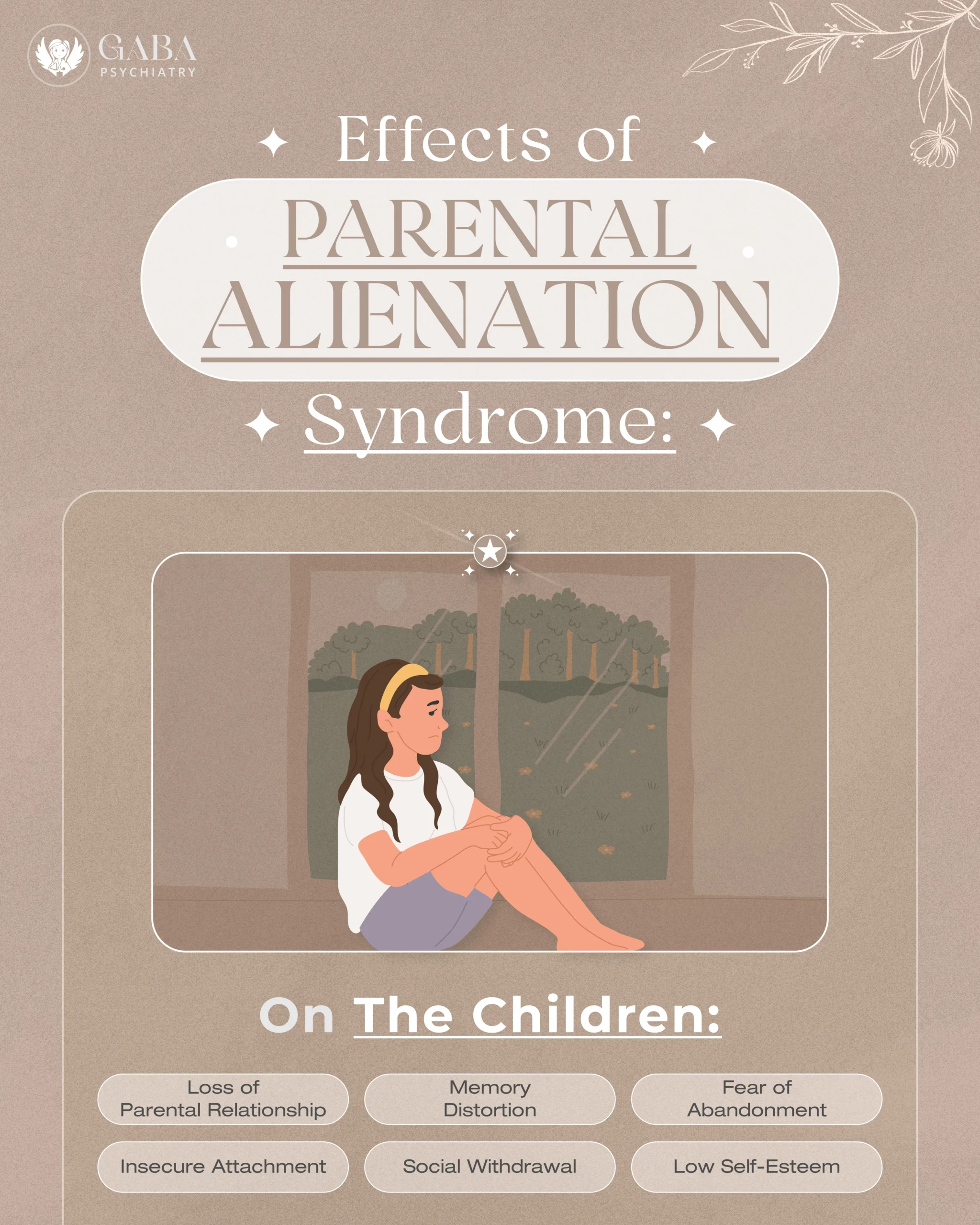
On Children:
Fear of Abandonment – The child sees, observes and may feel insecure, fearing they’ll lose the alienating parent’s love and support if they show any positive feelings toward the alienated parent.
Loss of Parental Relationship – Alienation from one parent can cause feelings of loss, grief, and sadness, similar to bereavement, as the child is losing a crucial relationship.
Memory Distortion – Children may confuse real and false memories of the alienated parent due to the alienating parent’s influence.
Social Withdrawal – Children might withdraw from social activities due to feeling misunderstood, leading to loneliness and isolation.
Insecure Attachment – Parental Alienation Syndrome may lead to insecure attachment and emotional closeness issues in children.
Low Self-Esteem – Internalizing blame and guilt can lead to a lasting negative self-image, damaging the child’s confidence and self-esteem. It can have a great impact on a child’s life.
On the Alienated Parent:
Guilt and Self-Blame – Alienated parents may feel guilty and self-blaming, doubting their parenting skills, considering themselves as a bad person and wondering if they could have prevented the estrangement.
Post-Traumatic Stress – In severe cases, feeling estranged from a child can cause PTSD-like symptoms, including intrusive thoughts, heightened alertness, and emotional numbness.
Strain on Social Relationships – Parental Alienation Syndrome can strain relationships with friends and family, as alienated parents may avoid social events and struggle to stay connected.
Marital Strain – If the alienated parent is in a relationship, Parental Alienation Syndrome can strain it. Disagreements on handling the situation, financial pressures, and emotional stress may lead to marital discord or separation.
Diminished Parental Role – Alienated parents may feel helpless and frustrated from missing important milestones and daily moments, impacting their ability to support and guide their child.

Is Parental Alienation based on Gender?
No, this could be practiced by either males or females. Studies suggest that females express their aggression indirectly, thus engaging more in gossips, spreading rumors, undermining the reputation of people they dislike, while males express aggression both directly and indirectly.


The Impact of Parental Alienation on the Targeted Parent:
The targeted parent usually experiences depressive moods, trauma symptoms, or even Post Traumatic Stress Disorder and in extreme vulnerabilities even suicidal ideation. Divorce or separation is already a draining process and when it is topped with a child custody battle with an ex-partner it can be a life-stirring phenomenon.
Parental Alienation Evaluation
Parental alienation evaluations help the court to understand if one parent is manipulating and trying to turn the child against the other parent. This evaluation focuses on analyzing the child’s behavior in relation to each parent. It also checks if there is any undue influence on the child from one parent to the detriment of the other. The main goal of the parental alienation evaluation is to protect the child’s best interests.
At GABA Telepsychiatry, our board-certified psychiatrists provide parental alienation evaluation. They discuss the family history and past issues with both parents and carefully examine whether any false allegations have been made or if there are false motives behind a parent’s claims or signs of parent undermining that could damage the child’s relationship with the other parent.
They also talk to the child and focus on evaluating the child’s functionality within family relationships while observing the alienating parent’s conduct for signs of manipulation. They investigate whether any underlying condition or mental disorder is present. After the evaluation process, they write a report for the court, which helps in making a fair decision for the child.
Benefits of parental alienation evaluation
- Parental alienation evaluation protects the child from psychological harm.
- Parental alienation evaluation shows if one parent is creating a false image of the other parent.
- Parental alienation evaluation helps the court in making a fair decision.
- Parental alienation evaluation promotes understanding and reduces conflict between parents.
- Parental alienation evaluation may also lead to better custody arrangements.
- Parental alienation evaluation rebuilds the trust and relationship between the child and both parents.
Parental Alienation Custody Evaluation
Parental alienation custody evaluation is a specialized type of evaluation that helps the courts and mental health professionals understand high-conflict parenting situations.
The main goal of this evaluation is to assess the level and impact of parental alienation on the child involved in the custody disputes. It focuses on promoting the child’s best interests and contributes to their overall well-being.
The parental alienation custody evaluation helps in uncovering the manipulation and emotional harm in issues like a parent lying about events or a parent accusing the other without evidence. These types of behaviors may influence custody decisions and carry serious legal consequences.
Some of the key steps of parental alienation custody evaluation are mentioned below:
Conduct a detailed assessment
Check for underlying reasons
It is important to check if the child’s rejection is due to real abuse or harm. If abuse is found, then the child’s response may be proactive and can not be labelled as alienation. This step is important to avoid misjudgment.
Collect third-party reports
Mental health professionals collect information from teachers, friends, and other family members to prepare a clear report. This report helps confirm facts and provides an accurate understanding of the relationship between parents and their child. Witness testimony can make a big difference in legal proceedings.
Observe signs of alienation
Assess the behavior of both parents
Recommend treatment options
The mental health professionals prepare a detailed report that includes therapy plans, detailed records, parenting support, changes in custody, and structured visits. They focus on rebuilding the trust and making the child feel safe and loved by both parents.
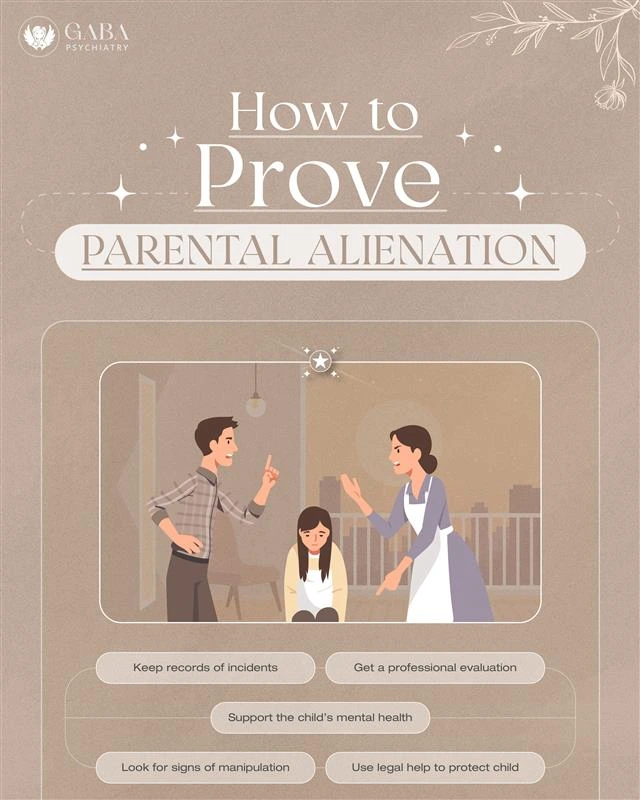
How to Prove Parental Alienation
Parental alienation happens when one parent emotionally manipulates the child to reject the other co-parent for unjust reasons, usually for the benefit of the alienating parent. Over time, the child may start feeling that the other parent is bad or feel unsafe around them, even when it is not true, causing severe damage to the relationship between the child and the alienated parent. Therefore, it is important to recognize and prove parental alienation to protect the emotional and overall well-being of the child.
A parental alienation evaluation can provide you with the right support and strong evidence to make a big difference when demonstrating parental alienation in court. It provides an in-depth examination of parental alienation and protects the child’s mental health. Professional evaluations help the child rebuild trust and connection with both parents. Understanding your legal options during this time can guide you through the right steps and ensure the child’s best interests remain the top priority.

Five Factor Model (FFM) for diagnosing Parental Alienation
The Five-Factor Model (FFM) is a method for diagnosing parental alienation by understanding and identifying the components of this condition. In parental alienation evaluation, board-certified psychiatrists may use FFM to diagnose PA.
- The Child Manifests Contact
- Resistance or Refusal, ie, Avoids a relationship With One of the Parents.
- The Presence of a Prior Positive Relationship Between the Child and the Rejected Parent.
- The Absence of Abuse, Neglect, or Seriously Deficient Parenting on the Part of the Rejected Parent.
- The Use of Multiple Alienating Behaviors on the Part of the Favored Parent.
The Child Exhibits Many of the Behavioral Manifestations of Alienation Identified in Gardner’s Seminal Paper.
How does proving parental alienation help?
- A court may change custody or visitation
- It can help address parental alienation before ongoing harm and manipulation cause more damage
- It protects the child’s mental health in the long term
- It plays a key role in stopping parental alienation early
Legal Options
Depending on the circumstances of the case, legal options may include requesting changes to custody or visitation, seeking enforcement of existing parenting orders, or requesting an appropriate professional evaluation, such as one conducted by a custody evaluator. A judge may consider the available evidence when determining whether a parent has interfered with court-ordered parenting time or the child’s relationship with the other parent. A Motion for Enforcement can be filed for possession violations. Courts may also impose penalties when a parent interferes with court-ordered contact or communication. The specific legal consequences vary depending on the facts of the case and the applicable state law.
How can GABA Telepsychiatry support parental alienation cases?
- Provides expert witness for parental alienation cases
- Offers psychiatric evaluations for the court
- Provides clear and professional reports
- Offers reunification therapy for child and parent
- Provides support in litigating parental alienation
- Offers psychoeducation to the family
How to Prove Parental Alienation in Court?
Proving parental alienation in court can be complex, and there are several ways to document behaviors and evidence that may be relevant to the case. Sometimes, family court child custody disputes involve abuse allegations. However, experienced family law attorneys gather sufficient evidence to convince the judge and guardian ad litem that parental alienation is occurring. This allows the court to take the right steps and help the child reunite with both parents.
Parental alienation is a serious concern in family law that impacts custody decisions and the child’s emotional well-being. The court may modify custody arrangements when there is a change in the family situation. The court can also approve a well-structured parenting plan on request to ensure the child feels safe and supported by both parents. In some cases, the court may impose penalties on the alienating parents for violating agreements or interfering with parental rights. The court understands and values the psychological well-being of the child.
In severe cases of parental alienation, the court may order supervised visitations to protect the child’s emotional safety while maintaining parental contact. Courts make custody decisions based on the child’s best interests.
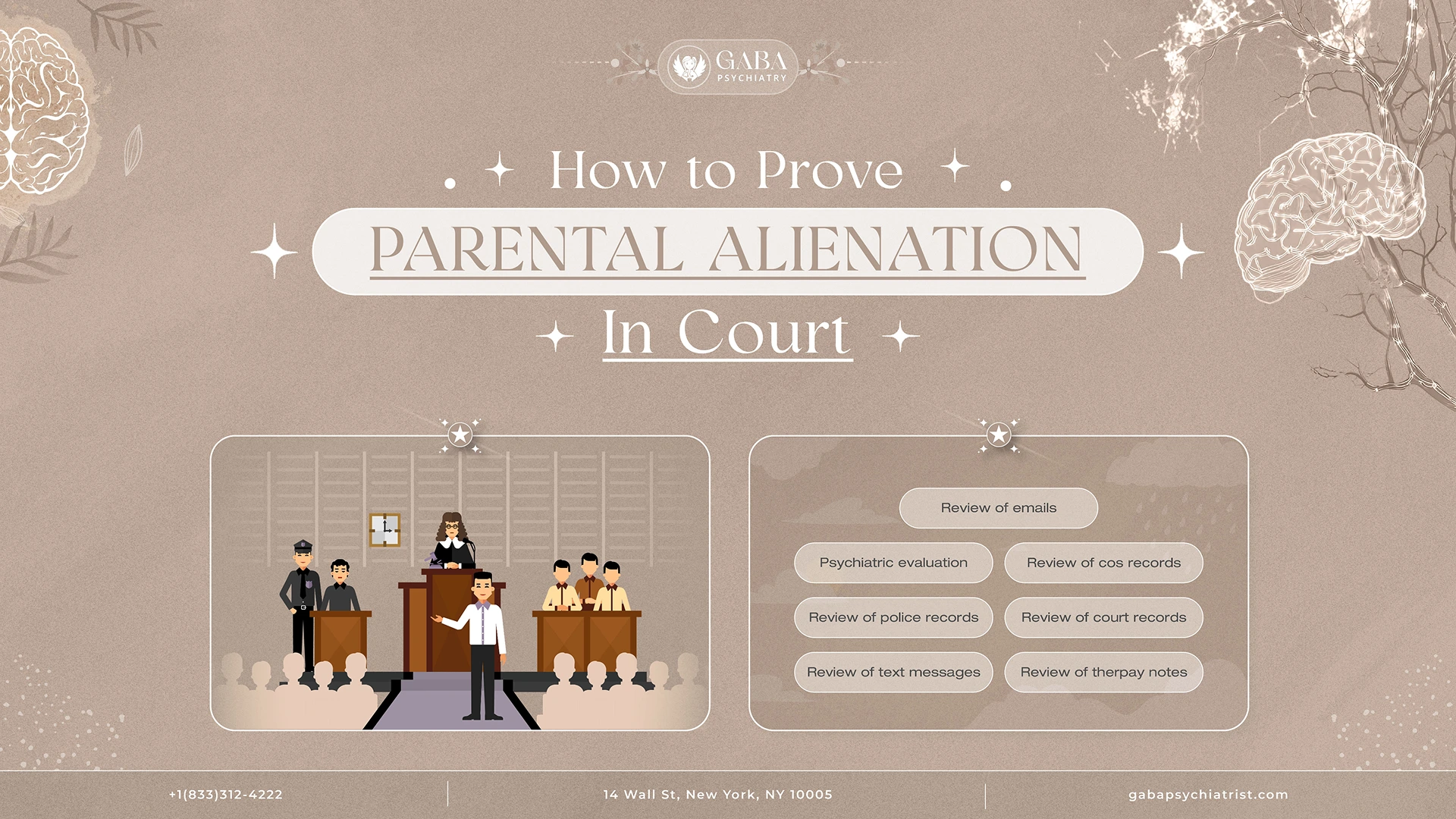

Steps to prove Parental Alienation in court
Keep a record of negative Comments
Record instances where the other parent has made slanderous remarks about the targeted parent to the child, such as derogatory statements, false accusations, or attempts to portray the targeted parent in a negative light.
Document behavioral changes in your child
It is important to keep detailed records of sudden changes in your child’s behavior. This unusually cruel and disrespectful behavior can indicate the influence of the alienating parent.
Present clear evidence of withholding
Provide evidence that the other parent has intentionally withheld the child from the targeted parent, including missed visits, last-minute cancellations or other important matters. It is important to keep a record of the alienating parent's actions to prove parental alienation during the legal process.
Track communication
patterns
Save communication records like emails, messages, phone calls and recorded conversations showing blocked or refused contact. This evidence demonstrates attempts to alienate the child from the targeted parent. Parents should not rely on a single incident when documenting a pattern of behavior; maintaining consistent records can provide greater context. It may also help demonstrate the parent’s ongoing efforts to maintain a relationship with the child.
Collect third-party
statements
You can ask for other witness statements from family friends, the child's teachers or coaches who observe the child’s behavior or hear comments. The third-party observations and powerful statements can help the court in making a fair decision.
Take help from an expert witness
In legal cases, the court only believes in evidence and looks for expert input. Therefore, GABA Telepsychiatry connects you with a parental alienation expert witness who offers professional assessments to support your claim.
How to Prevent Parental Alienation?
In legal proceedings, child custody cases involving Parental Alienation Syndrome often require expert testimony and evidence showing that a parent is undermining the child’s relationship with the other parent. If you suspect parental alienation, early legal advice and intervention are important for the child’s well-being. Although it can affect custody decisions, its influence differs from case to case, making parental alienation treatment and exploration of options crucial for parents.
In severe cases, the child may display intense hatred for the unfavored parent and both the child as well as the alienating parent refuse to attend joint meetings or even address the concerns. Therefore, a psychiatric evaluation may help recognize parental alienation at an early stage and support the emotional well-being of the child.
In conclusion, Parental Alienation happens when two parents separate or divorce, and it disrupts the family system. In this phase, it is ideal to opt for shared parenting and a well-structured parenting plan, keeping in mind that love and responsibility for one’s child is greater than hatred for one’s ex-partner. If this default option is not voted for, it has the potential to cause irreparable damage to the unfavored parent and the child. Additionally, it is critical to identify and accept such happenings and proactively work to safeguard everyone’s mental health in the process.
Most importantly, don’t be afraid to seek professional help when you require it.


Reference
The Impact of Parental Alienating Behaviours on the Mental Health of Adults Alienated in Childhood
An introduction to parental alienation syndrome
Losses experienced by children alienated from a parent

How to document parental alienation?
Parental alienation is a serious issue that can impact the relationship between a parent and child. Documenting parental alienation is an important step to protect the child’s emotional well-being. Accurate and detailed parental alienation documentation is most effective when it shows a consistent pattern over time and can work as evidence to support the custody case in court. Board-certified psychiatrists at GABA Telepsychiatry have helped in many custody cases. We understand that parental alienation is a challenging experience, but thorough documentation can help in rebuilding a healthy connection with the child.
Why is Documenting Parental Alienation Important?
Documenting parental alienation is important because alienating parents may appear cooperative on the surface while engaging in manipulative behavior behind closed doors. Courts are usually less persuaded by isolated incidents than by repeated conduct. Therefore, proper documentation can help in:
- Identifying patterns of alienating behaviors
- Offering evidence for court or legal professionals
- Strengthening the parent-child bond
- Protecting the child’s best interests
Steps to Document Parental Alienation:
- Write down every incident:
Keep a journal or notebook and write down the events that indicate alienation. Include specific dates, times, and descriptions of incidents, such as missed visitations, negative statements or refusal of contact, so you can show long-term patterns when possible.
- Save copies of text messages and emails:
Save all forms of communication between you and the alienating parent. Take screenshots or save copies of any message that shows a negative conversation. This includes text messages, emails, phone calls, and school records. - Collect evidence of efforts:
Show evidence of your efforts to maintain a healthy relationship with your child, including gifts, cards, fun activities, or attempts to communicate. This helps the court to make a fair decision. - Collect witness testimonies:
Third-party observations can be strong proof and can support your claims. Reach out to teachers, friends, family members or mentors if they have observed alienating behavior and ask them to write what they saw. - Request professional evaluations:
Ask for help from a board-certified psychiatrist or a mental health expert. Their reports can help in legal cases and can confirm signs of alienation. - Write down the pattern of manipulation:
Look for recurring incidents and tactics used by the alienating parent, such as false allegations, unanswered calls or emails and emotional manipulation. Your notes should support parental alienation claims with specific examples.


Parental Alienation Treatment
Mental health professionals provide parental alienation treatment, including family therapy, depending on the severity of parental alienation experienced by the child.
If parental alienation is of mild intensity, the child can benefit from parenting time and psychoeducation. In cases of moderate to severe parental alienation, the child will benefit from regular counseling and joint sessions by the parenting coordinator to minimize the exposure of parental conflicts and improve communication.
The psychological community addresses parental alienation disorder and offers reunification therapy to repair disrupted relationships and reduce the negative feelings that a child may develop towards the custodial parent. Courts may also explore legal remedies to protect the child, and in appropriate cases, order therapy to help repair the parent-child relationship, especially when a parent’s behavior contributes to the alienation.
However, this is subject to the agreement of both parents in owning the joint responsibility of their child’s mental health. In some cases, the court may modify custody arrangements if alienation continues despite efforts to resolve. An experienced attorney can guide the parents through appropriate legal steps.
The treatment aims to address the root causes of alienation and rebuild the disrupted relationship between parent and child. Effective parental alienation treatment, including parental alienation syndrome therapy, focuses on healing the rift and restoring the child’s connection with both parents.


Parenting Time
Regular parenting time supports the child's ability to rebuild and sustain a relationship with the alienated parent. This parental alienation treatment option could help counteract the alienation efforts of the other parent. The focus should be on fostering quality interactions during parenting time. Parents are encouraged to participate in activities that enhance the bond and create positive experiences.
Unification Therapy
Unification Therapy is another parental alienation treatment option that assists the child in rebuilding a healthy and positive relationship with the estranged parent, especially for parents who are feeling lost during the process. It involves addressing and resolving the psychological and emotional issues that are contributing to the alienation. It focuses on improving communication and understanding the child's as well as the parent's perspective to rebuild trust.
Psychoeducation
Psychotherapy offers both the parent and the child insight into Parental Alienation Syndrome, covering its symptoms, causes, and impact on children and family dynamics. A psychiatrist or parenting coordinator who is experienced in adolescent psychiatry can help parents recognize and understand an alienating parent's behaviors and their effects on the child's mental health. They may also review the child's social media posts for signs of emotional distress or influence from the alienating parent. They offer unwavering support to both the child and the parents, helping to repair the relationship between them.
Financing Partners
During legal issues, high stress levels can cause a mental breakdown. The additional expense of the legal fees can make the situation worse than it already is. Mostly, individuals find themselves in the middle of dealing with the pressure of costs and financial burden.
To help reduce the burden, Gaba Telepsychiatry works with financing partners who offer flexible payment arrangements with short-term options for eligible people.
If interested in learning more about our financing options, please feel free to talk to one of our patient advocates, as they can help you understand the available options to find out which option works best for you
A person with bad credit due to legal fees but a good payment history, may still be eligible for financing and payment plans, but the rates would be typically higher. In some cases we have in house payment plans, but not if there are court dealings.



Our Trusted Clients
I am an attorney in Missoula, MT. I had the pleasure of working with Dr. Reddy in a divorce action. She was thorough and prompt. I would…Read More
highly recommend her as a huge advocate for your client in common.
Dr Reddy’s word in your FAA medical cases carries some heavy weight. She is a consummate professional and is extremely knowledgeable in every aspect of maneuvering the obstacles that are in place. She was able to get me back up and flying within 3 months! This was not an easy task, however due to her expertise, she was able to produce the correct and desired responses from the agency …Read More
and highlight definitive facts which supported my claims, thus returning me to the job and my passion. Without her, it would not have been possible! I know this as a fact because I have a friend who was in the same situation, who used another service provider that could not convince the agency based upon his claims and was permanently grounded. I highly recommend and will continue to utilize Dr. Reddy!!!!!!!
FAQ
Early detection and action are the most effective approaches. The longer the alienating behaviors are allowed to continue, the greater the damage.
- Request unification therapy
- Ask for a co-parenting therapist
- Ask for the alienating parent to be held to account
You should collect all the texts and emails exchanged with the other parent and document any behavioral changes as evidence.
Document a timeline of events and evidence that a once-close relationship has abruptly turned without cause.
Start unification therapy. What often comes out is that the child is
- Providing frivolous reasons for rejection and cruelty to one parent.
- It is showing unequivocal support of one parent against the evidence.
- Making allegations that are inconsistent with the evidence.
Start your journey toward healing and a stronger family connection today

